Jimmie Rodgers: His Tragic Life and Musical Legacy (Audio Documentary) [LISTEN]
He sang about working people.
He sang about trains, sickness, love, and movement.
He only lived 35 years but he reshaped American music forever.
He was called the Singing Breakman and America’s Blue Yodeler.
And today, he’s known as the Father of Country Music.
His voice, his songs, and his yodel changed what popular music could be.
He gave country music a voice.
And now, almost 100 years later, the world is still listening.
His name was Jimmie Rodgers.
Roots and Early Life
James Charles Rodgers was born on September 8, 1897 in Meridian, Mississippi.
Rodgers grew up tied to the railroad.
His father, Aaron Rodgers, worked for the Mobile and Ohio Railroad.
The family moved often, following the tracks.
Rodgers’ childhood was unsettled.
His mother died in 1903, when he was six.
After her death, his schooling was irregular and often interrupted.
Music entered his life early.
Vaudeville shows, theaters, and street performances shaped his taste.
At age 13, he won a local singing contest.
Soon after, he joined a traveling medicine show.
It was his first life on the road.
The Railroad Years
Rodgers left school and joined the railroad.
He started as a waterboy for Black gandy dancer crews.
From them, he absorbed work songs, blues phrasing, and rhythm.
He worked many jobs.
Baggage handler.
Flagman.
Eventually, brakeman.
The railroad gave Rodgers his image.
It also gave him his sound.
Illness Changes Everything
In 1924, Rodgers was diagnosed with tuberculosis.
He was 27 years old.
The illness made railroad work impossible.
By 1927, he left the rails for good.
Music became his only path forward.
Bristol and the Breakthrough
In 1927, Rodgers joined the Tenneva Ramblers.
They worked briefly on radio, then played resorts in the Blue Ridge Mountains.
That summer, Rodgers learned of recording sessions in Bristol, Tennessee.
They were run by Ralph Peer for the Victor Talking Machine Company.
Just before the session, Rodgers argued with his band.
They walked away.
Rodgers recorded alone.
Blue Yodel No. 1
A second session followed in Camden, New Jersey.
On November 30, 1927, Rodgers sang a song Peer had never heard before.
It was called Blue Yodel.
Released as “Blue Yodel No. 1 (T for Texas),” it became a national hit.
It sold over one million copies during Rodgers’ lifetime.
Country music had its first true star.
Fame and Innovation
Rodgers recorded more than 120 songs.
He blended blues, folk ballads, vaudeville, jazz, and railroad themes.
His yodel used a steady 4/4 rhythm.
It was raw, playful, and direct.
His songs told stories of love, travel, sickness, work, and loss.
They spoke to everyday Americans.
Health Declines, Music Continues
Despite worsening tuberculosis, Rodgers kept working.
He toured constantly.
He recorded whenever his strength allowed.
In 1929, he settled in Kerrville, Texas.
Doctors believed dry air might help.
He named his home Blue Yodeler’s Paradise.
Late Career Highlights
Rodgers collaborated across genres.
He recorded with the Carter Family.
He recorded with Louis Armstrong on “Blue Yodel No. 9.”
He wrote “T.B. Blues,” directly addressing his illness.
Even as sales fell during the Great Depression, his influence grew.
Final Recordings and Death
In May 1933, Rodgers traveled to New York for one last session.
He recorded while seated, supported by pillows.
He rested between takes on a cot.
On May 26, 1933, he collapsed in his hotel room.
He died later that night.
He was 35 years old.
Legacy
At the time of his death, Rodgers accounted for ten percent of RCA Victor’s sales.
His music outlived him.
He was inducted into the Country Music Hall of Fame in 1961.
The Rock and Roll Hall of Fame in 1986.
The Songwriters Hall of Fame in 1970.
His influence reached far beyond country music.
From blues to rock to folk.
From the American South to Africa.
Closing
Jimmie Rodgers sang about working people.
He sang about trains, sickness, love, and movement.
He gave country music a voice.
And the world never stopped listening.
Travel Back in Time to the 1920s and 1930s!
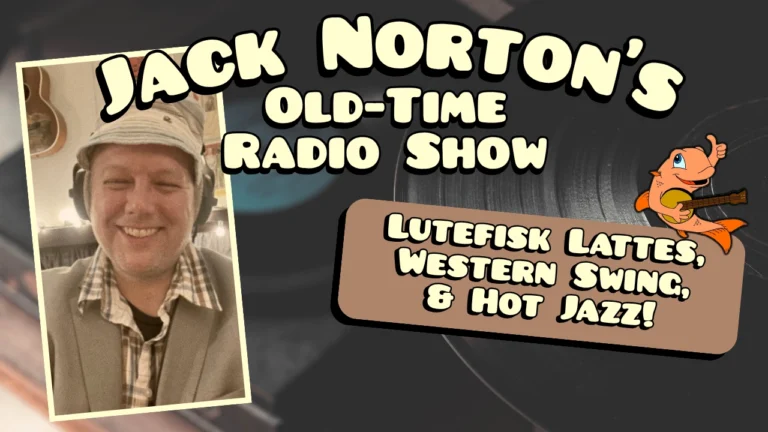
Heigh-ho, everybody, heigh-ho! Kitty and I just released this special bonus episode of our weekly radio show and podcast – Jack Norton’s Old-Time Radio Show. Uff-da, this is a good ol’ good ‘un! Here’s some info on the program…
Travel back to the 1920s, 1930s, and 1940s as vaudeville blues and ragtime hokum musician Jack Norton spins his favorite 78 rpm records from his collection. From early hot jazz to jug band blues, hillbilly hits to novelty swing, Jack’s love for vintage tunes shines through with every tune he drops on the turntable. Sit back, relax, and let the soothing retro vibes of the good old days soothe your weary soul.
If the good Lord’s willin’ and the creek don’t rise, new episodes drop every Tuesday.
Wanna request a tune or need advice answered with a song? Email me at: hello@jacknortonmusic.com
Cheers,
Jack
Support the Show!
Looking for a fun way to show your support and get cool bonus content like members-only episodes, behind-the-scenes videos and photos, and more? Check out our Patreon page! Jack Norton’s Old-Time Radio Show is a true labor of love and we sincerely appreciate your support. For just $5 a month you can really help out the show, and get awesome bonus goodies! You can also buy an episode for just $3 without becoming a member. Got a question about membership? Email us: hello@jacknortonmusic.com – thanks so much for your help!



![Jack Norton’s Old-Time Radio Show – Episode 16: Christmas Crooners, Jingle Bell Jazz, and Holiday Hokum: Part 2 [LISTEN]](https://jacknortonmusic.com/wp-content/uploads/2025/12/OldTimeRadioShow_Ep17-768x432.webp)